Reading & Languages
Super Word Magic
Match letters, spell words, learn to read

Welcome back
Reading & Languages
Match letters, spell words, learn to read

Communication & Code
Tap and hold to the beat, learn Morse code
Human Biology
Tower defense inside the body
Chemistry & Physics
Build a team of atoms and battle with real molecules
History
Command your forces through the turning points of history
Physics
Aim, launch and master real projectile physics
Opettajalle
The School of Gamesin peleissä oppiminen on itse peli: tavoitteet on rakennettu pelimekaniikkaan, ei liimattu sen päälle. Pelit ovat maksuttomia, eivätkä ne vaadi tunnuksia, kirjautumista tai henkilötietoja. Ne toimivat selaimessa puhelimella, tabletilla ja tietokoneella.
Pelien oppimissisältö on käyty läpi perusopetuksen opetussuunnitelman perusteita (POPS 2014) vasten. Neljä peliä harjoittaa suoraan 36 tavoitetta ja tukee lisäksi 54:ää.
Mitä oppiaineita ja vuosiluokkia pelit tukevat. Napauta kuvaa nähdäksesi sen isompana.
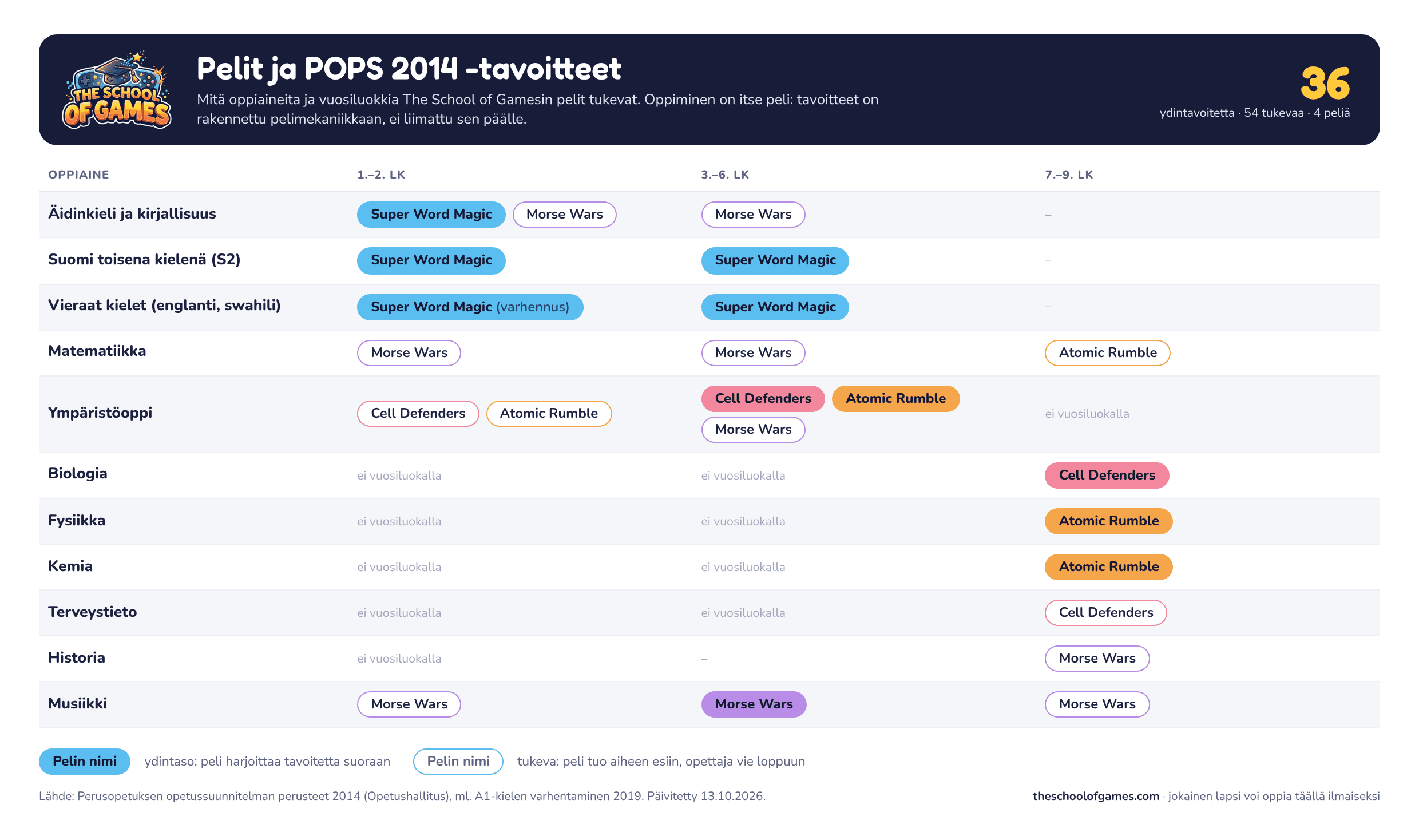
13 sivua: tavoitekoodit peleittäin ja jokaisesta tavoitteesta, miten peli sen täyttää.
Äidinkieli 1.–2. lk, suomi toisena kielenä 1.–6. lk, varhennettu A1-kieli sekä englanti ja swahili 3.–6. lk
ÄI 1–2 T5ydinValitse oppimiskieleksi suomi ja asetukseksi ”Vain kuvat”. Lapsi näkee kuvan, kuulee sanan ja kokoaa sen kirjainlaatoista. Näin äänne, kirjain ja sana yhdistyvät, ja tarinatasojen lauseet vievät sanasta virkkeeseen.ÄI 1–2 T13ydinPelissä on kolme kerrottua satua, joissa teksti korostuu ääneenluvun tahdissa. Heijasta satu taululle ja lukekaa yhdessä mukana.S2 1–2 T4ydinI speak X -tilassa vihje annetaan kuvana ja oppilaan kotikielellä, ja hän kokoaa suomenkielisen sanan kirjainlaatoista. Sopii valmistavaan opetukseen ja aloitteleville S2-oppijoille.EN A 3–6 T3ydinPatterns-korteissa oppilas ratkaisee ensin kortin ja lukee sitten Why?-säännön. Vaihtakaa kielivalitsimesta oppimiskieltä ja vertailkaa, miten monikko muodostetaan suomessa, englannissa ja swahilissa.EN A 3–6 T7tukevaStory-dialogien kysymys–vastaus-parit toimivat valmiina malleina parikeskusteluihin.
Ympäristöoppi 3.–6. lk (parhaiten 5.–6. lk), biologia ja terveystieto 7.–9. lk
YO 3–6 T12ydinOppilas oppii säännön ensin pelaamalla (makrofagi nielee bakteerin, NK-solu hyökkää vain virusinfektoituun soluun) ja saa sille sitten oikean nimen. Kootkaa pelin jälkeen taululle, miten arkinen ”pöpö” tarkentuu käsitteiksi bakteeri, virus, vasta-aine, tulehdus ja allergia.BI 7–9 T7ydinTasolla 22 käynnistyy ketju antigeeni → koulutus imusolmukkeessa → vasta-aineet, ja tasolta 23 alkaen kapselibakteerit vaativat sitä: vasta-aine merkitsee kapselin, ja makrofagi nielee. Pyydä oppilaita piirtämään ketju ja selittämään se omin sanoin.BI 7–9 T5ydinLungs- ja Heart-alueilla pelaaja seuraa hengitysteiden haarautumista keuhkorakkuloihin ja kaasujenvaihtoa sekä sydämen läppiä, sykettä ja verisuonia. Pelatkaa alue ennen jakson tuntia ja verratkaa oppikirjan kuvaan.TE 7–9 T6tukevaVoittotekstit ja imusolmukeoppitunti kertovat, mitä kurkkukipu, nuha tai turvonnut imusolmuke tarkoittaa. Hyvä aloitus keskusteluun itsehoidosta.
Kemia ja fysiikka 7.–9. lk, ympäristöoppi 5.–6. lk
KE 7–9 T14ydinAtom Bookissa oppilas selaa koko jaksollista järjestelmää ja voi suodattaa sitä alkuaineperheen tai olomuodon mukaan. Anna tehtäväksi etsiä huoneenlämmössä nestemäiset alkuaineet ja selittää, miksi Hot Plate (473 K) tai Liquid Nitrogen (77 K) muuttaa kortin olomuotoa.KE 7–9 T10ydinPelissä on 28 reaktiokorttia tasapainotettuina reaktioyhtälöinä (esim. 2 H₂ + O₂ → 2 H₂O). Oppilaat kirjoittavat pelin reaktion vihkoon ja tarkistavat, että atomeja on yhtä paljon molemmin puolin, kuten pelin reseptit vaativat.FY 7–9 T10ydinHajoamisketjussa U → Th → Ra → Rn → Po → Pb oppilas näkee, että α-hajoaminen pienentää järjestyslukua kahdella. Piirtäkää ketju taululle ja merkitkää jokaisen vaiheen muutos.YO 3–6 T18ydinKortit näyttävät, onko aine kiinteä, neste vai kaasu, ja palamisreaktiot sen, mitä palamisessa syntyy. Kun yhdiste hajotetaan ja rakennetaan uudelleen, mikään ei katoa: hyvä alku aineen säilymisen periaatteelle.
Musiikki 3.–6. lk, tukena äidinkieli, matematiikka, ympäristöoppi ja historia; pelattavissa 2. luokalta alkaen
MU 3–6 T7ydinPutoavat laatat ovat kestonmerkintää: lyhyt laatta on dit, pitkä dah (kolme ditiä). Taputtakaa muutama kirjain yhdessä rytmissä ennen pelaamista, niin merkintä ja soittaminen kohtaavat.MU 3–6 T9ydinJokaisella kirjaimella on hallintataso 0–5, ja lämpökartta näyttää, mitkä kirjaimet kaipaavat harjoittelua. Pyydä oppilasta valitsemaan itse seuraava harjoittelukohde ja seuraamaan edistymistään.MA 3–6 T7tukevaMallisana PARIS on 50 ditin mittainen. Laskekaa, montako ditiä minuutissa tarvitaan, jotta nopeus on 10 sanaa minuutissa (WPM).YO 3–6 T8tukevaSOS-oppitunti ja avunpyyntöviestit (esim. TULKAA APUUN) avaavat keskustelun siitä, miten hätätilanteessa toimitaan.HI 7–9 T7tukevaLennätinoppitunti (Samuel Morse ja Alfred Vail, 1844) antaa lähtökohdan pohtia, miten sähköinen viestintä muutti teollistuvaa yhteiskuntaa. Sijoittakaa lennätin ja SOS aikajanalle.Tavoitekoodit: ÄI äidinkieli ja kirjallisuus · S2 suomi toisena kielenä · EN englanti · MA matematiikka · YO ympäristöoppi · BI biologia · FY fysiikka · KE kemia · TE terveystieto · HI historia · MU musiikki · T = opetuksen tavoite. Lähde: Perusopetuksen opetussuunnitelman perusteet 2014 (Opetushallitus), ml. A1-kielen varhentaminen 2019.
For teachers
In the School of Games, learning is the game itself: the learning goals are built into the game mechanics, not stuck on top of them. The games are free and need no accounts, sign-in or personal details. They run in the browser on phones, tablets and computers.
The games’ learning content has been reviewed against the Finnish national core curriculum for basic education (2014). The four games practise 36 of its goals directly and support 54 more.
Which subjects and grades the games support (chart in Finnish). Tap the chart to see it larger.
Native language grades 1–2, second language grades 1–6, early foreign language grades 1–2, English and Swahili grades 3–6
Native language · grades 1–2coreSet the learning language to your native tongue and turn on “Pictures only”. The child sees a picture, hears the word and builds it from letter tiles, linking sound, letter and word; the story levels then carry the words into sentences.Native language · grades 1–2coreThe game has three narrated stories in which the text is highlighted in time with the reading. Put a story on the board and read along together.Second language · grades 1–2coreIn I speak X mode the clue is given as a picture and in the pupil’s home language, and the pupil builds the word in the new language from letter tiles. Works well in preparatory classes and for pupils who are new to the language.English · grades 3–6coreOn the Patterns cards the pupil first solves the card and then reads the Why? rule. Switch the learning language and compare how plurals are formed in your native tongue, English and Swahili.English · grades 3–6supportingThe question-and-answer pairs in the Story dialogues work as ready models for pair conversations.
Environmental studies grades 3–6 (best in grades 5–6), biology and health education grades 7–9
Environmental studies · grades 3–6corePupils learn each rule by playing first (a macrophage swallows a bacterium, an NK cell attacks only virus-infected cells) and then get its proper name. After playing, gather on the board how everyday “germs” sharpen into the concepts bacterium, virus, antibody, inflammation and allergy.Biology · grades 7–9coreFrom level 22 the chain antigen → training in the lymph node → antibodies starts, and from level 23 capsule bacteria need it: the antibody marks the capsule and the macrophage swallows it. Ask pupils to draw the chain and explain it in their own words.Biology · grades 7–9coreIn the Lungs and Heart areas players follow the airways branching into the alveoli and gas exchange, and the heart’s valves, heartbeat and blood vessels. Play an area before the lesson and compare it with the textbook picture.Health education · grades 7–9supportingThe victory texts and the lymph node lesson explain what a sore throat, a runny nose or a swollen lymph node means. A good way into a conversation about self-care.
Chemistry and physics grades 7–9, environmental studies grades 5–6
Chemistry · grades 7–9coreIn the Atom Book pupils browse the whole periodic table and can filter it by element family or state of matter. Ask them to find the elements that are liquid at room temperature and explain why Hot Plate (473 K) or Liquid Nitrogen (77 K) changes a card’s state.Chemistry · grades 7–9coreThe game has 28 reaction cards written as balanced equations (e.g. 2 H₂ + O₂ → 2 H₂O). Pupils copy a reaction from the game and check that there are as many atoms on both sides, just as the game’s recipes require.Physics · grades 7–9coreIn the decay chain U → Th → Ra → Rn → Po → Pb pupils see that alpha decay lowers the atomic number by two. Draw the chain on the board and mark the change at each step.Environmental studies · grades 3–6coreThe cards show whether a substance is a solid, liquid or gas, and the combustion reactions show what burning produces. When a compound is broken down and built again, nothing disappears: a good start for the conservation of matter.
Music grades 3–6, supporting native language, mathematics, environmental studies and history; playable from grade 2
Music · grades 3–6coreThe falling tiles are a form of rhythm notation: a short tile is a dit, a long one a dah (three dits). Clap a few letters together in rhythm before playing, so notation and playing meet.Music · grades 3–6coreEvery letter has a mastery level from 0 to 5, and a heat map shows which letters need practice. Ask pupils to choose their own next practice target and follow their progress.Mathematics · grades 3–6supportingThe standard word PARIS is 50 dits long. Work out how many dits per minute are needed for a speed of 10 words per minute (WPM).Environmental studies · grades 3–6supportingThe SOS lesson and the calls for help in the game open a conversation about what to do in an emergency.History · grades 7–9supportingThe telegraph lesson (Samuel Morse and Alfred Vail, 1844) is a starting point for discussing how electric communication changed an industrialising society. Place the telegraph and SOS on a timeline.Each example names the subject and grades of the curriculum goal it supports. Source: Finnish National Agency for Education, National Core Curriculum for Basic Education 2014, including the 2019 amendment on early language learning.
About
The School of Games is a place where learning goals are integrated in the gameplay. Choose a game, start playing – and you'll learn without even noticing it's happening.
Games. Pick a game and tap Play. New games are added as they are finished.
Progress. See your levels, wins and practice time for each game and subject.
Awards. Earn trophies for playing, learning and coming back.
On your phone. Add this page to your home screen to use it like an app.
No account or sign-up is needed. The school does not ask for names, email addresses or any other personal details.
To show progress and improve the games, each device gets a random anonymous number, and the school records visits, time played and game results under it.
Saved game progress is backed up under the same number, so it can be put back if a device loses it.
In the app, the school keeps each game's saved progress on this device.
This is a place where learning goals are integrated in the gameplay. Choose a game, start playing – and you'll learn without even noticing it's happening.
Have Fun!
Add The School of Games to your home screen. It opens full screen, just like an app.
Trophies
Progress data
Screens and pop-ups
Sound
App
Language
The school and its games use this language.
Sound
Contact
Game data
Are you sure?